Mission 1. Growing Patterns
Pattern TrackerNumber & Algebra50 min
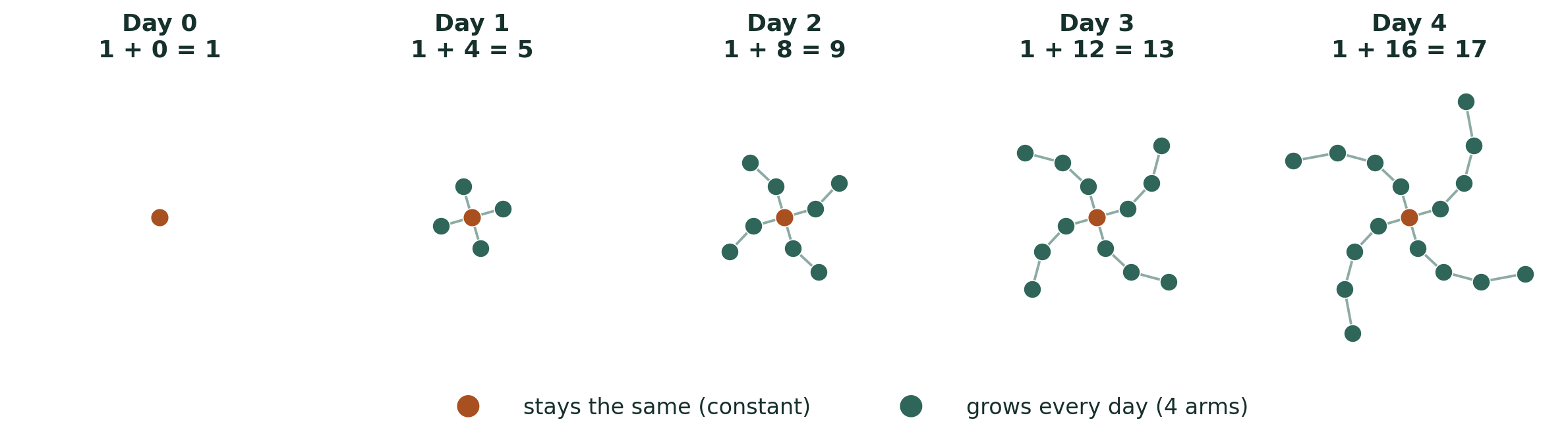
A pattern is growing bigger, one step at a time. Your job as Pattern Tracker: find the part that never changes, find the part that grows, and use that to build a rule.
We are learning to
- See that a growing pattern has a part that stays the same (constant) and a part that grows each step.
- Turn a growing pattern into a table of values.
- Write a simple rule for the pattern and use it to make a prediction.
Success criteria, I can
- I can point out what stays the same and what grows in a pattern.
- I can fill in a table showing how a pattern grows day by day.
- I can write a rule for my pattern and use it to predict a future day.
From the worksheet
Adapting this mission to your community
- Local Aboriginal and/or Torres Strait Islander art and design traditions often feature bold, repeating pattern work. If a local artist or Elder is willing, invite them to share how a pattern or design grows or repeats, rather than assuming or prescribing a design yourself.
- Let students' own answers to “what does this remind you of” guide any personal or cultural connection, and don't assign one for them.
Before you teach this
This mission uses a placeholder context. Please localise names, places, and any cultural knowledge in consultation with local Traditional Owners, Elders, or community members, and only include specific cultural knowledge that has been given permission to share.
Source
This mission is adapted from Chris Matthews' “Growing Patterns” exemplar in Teaching Mathematics from a Cultural Perspective (State of Victoria, Department of Education and Training, 2020), used under CC BY 4.0, and from the Goompi Model.
Download this mission
The PDF is what you print. The Word file is what you edit, so you can swap in a local species, a local seasonal calendar, or local place names before the lesson.